What No One Tells You About Starting an Etsy Shop: 4 Myths That Hold Sellers Back

Let me guess: you’ve been thinking about starting an Etsy shop for months—maybe even years—but you keep talking yourself out of it.
Etsy’s too crowded.
You’re not creative or a designer.
Why would anyone buy from you?
I know, because I did the same thing.
I first thought about opening an Etsy shop in April 2022, right after Etsy had exploded during COVID. I’d listen to podcasts about people who started shops during the pandemic and grew them almost overnight.
But it was 2022, life was back to normal. The moment felt over. So I convinced myself I’d missed it.
Still, the idea never really went away. I’d keep coming back to it — replaying the same what-ifs and wishing I’d started sooner. Eventually, I decided, “I’m just going to do it. If other people can do this, then so can I.”
So, a year and a half after first thinking I should do it, I finally opened my first shop - selling digital templates.
It was slow. A handful of sales over the first 6 months. But it was fun! I loved learning Canva (my design tool of choice) and I loved creating. And I loved those cha-chings even if they were few and far between.
In March 2024 (after saying I was NOT going to sell print on demand) I added print-on-demand t-shirts to my shop. My sales continued to trickle in slowly, but my confidence was growing.
Then, in August 2024, after spending the summer researching successful shops and analyzing products that were selling well, I opened a second shop with a completely different approach: I chose a giftable product and I designed with a message-first mindset. I wanted my products to be personalizable, but more than that I wanted them to be PERSONAL. I wanted my products to feel like they were made for the recipient.
That shop hit 3,400 sales in just over a year.
The difference wasn’t luck or timing. It was finally understanding what actually works—and letting go of the myths that had kept me playing small.
Let’s break them down.
Myth #1: Etsy Is Oversaturated
Come on — you’ve heard it, you’ve thought it, maybe both.
It's easy to believe Etsy is too crowded. You search for "teacher gift," "birthday candle," or "custom mug," and suddenly you're staring at thousands of listings that all look the same. It feels impossible to stand out—like everything worth selling has already been done.
That's exactly what I thought.
But here's the truth: Etsy isn't oversaturated—it's repetitive. Yes, there are millions of listings, but most of them are carbon copies of each other. Similar fonts. Similar phrases. Same Canva templates slightly rearranged.
What looks like saturation is really just sameness. And sameness is your biggest opportunity.
When I finally understood that, everything shifted. I stopped seeing competition as a bad thing and started seeing it as proof that there was demand. If people were buying those products, that meant they were already searching for something in that niche—they just hadn't seen my version yet.
That mindset change is what led me to adopt one of my favorite mottos:
"A little different and a little better."
When I see the same idea over and over, I ask myself—how could I make this a little different and a little better? That question has guided every product I've made since.
And you can see this mindset everywhere once you start looking for it: Stanley made water bottles colorful and giftable. Bombas made socks comfortable with purpose. Crumbl made cookies feel new every week. They all took something ordinary and made it personal, intentional, and meaningful—just a little different, and a little better.
The same is true for print-on-demand. You're not inventing candles or mugs—you're just putting better messages on them.
You don't have to reinvent the wheel to stand out—just rethink how it rolls. Whether it's a water bottle, a candle, or a t-shirt, small shifts in design, message, or purpose can completely change how people connect with it.
Because people don't scroll Etsy looking for "another mug." They're searching for something that feels exactly right for the person they're buying for—something that makes them think, that's so her.
So no, Etsy isn't too crowded. It's just waiting for someone to create products that feel personal instead of generic.
That someone could be you.
Myth #2: You Have to Be a Designer
This is the myth that stops so many people before they even try.
"I'm not creative or artistic."
"I can't design."
"I've never used Canva."
I hear it all the time. And I get it—when you look at beautiful, polished product listings, it's easy to think you need some special skill set you don't have.
But here's what I want you to know: I'm not a designer either.
I'm a middle school teacher. I've spent 20 years teaching kids how to problem solve. I don't have a design degree. And before I opened my Etsy shop, I had never used Canva.
And yet, my POD shop has made thousands of sales in 13 months.
Because here's the truth that a lot of people miss: Simple sells.
The products that perform best in my shop aren't the ones with elaborate graphics, fancy fonts, or complex layouts. They're the ones with a great message and clean, simple design. They're text based. And they are soooo easy to make!
Most successful POD products are just text. Good text, thoughtfully placed on the right product.
You don't need design skills. You need to understand what makes someone feel seen, understood, or connected to a product. That's not about mastering software—it's about noticing what makes people laugh, what inside jokes they share, what quirks define them.
If you can write a text message that makes your friend laugh, you can create a POD product that sells.
The designing? That's the easy part. Canva has templates. Fonts are built in. You can create a best-selling product in 5 minutes once you know what message you want to put on it.
The hard part—the part that actually matters—is figuring out what to say. And that's not a design skill. That's observation. That's empathy. That's understanding your customer.
So no, you don't have to be a designer. You just have to be willing to pay attention to the people you're creating for—and let the message do the work.
Myth #3: Personalization Just Means Adding a Name
Most POD sellers think personalization is simple:
Add a name field, let customers type in “Sarah” or “Mom,” and boom—personalized product created!
And yes, that is personalization.
But that alone isn’t the kind that sells.
If that’s all you’re doing, you’re missing a huge opportunity.
Here’s what most sellers don’t understand: the best personalization isn’t just about customizing a name or date — it’s about creating products that feel personal to who someone is.
There’s a major difference between a product that says “Sarah’s Journal” and one that says “The Mindless Ramblings of a Fitness-Obsessed Dog Lover” with Sarah’s name at the bottom.
One just has her name on it.
The other captures something about her — her quirks, her habits, her personality, the things people love about her.
That’s the kind of personalization that makes products giftable.
The kind that makes people stop scrolling and think, “This is so Sarah — I have to get this.”
Real personalization isn’t just:
Adding a name ✓
Adding a date ✓
It’s also:
Capturing who they are as a person
Referencing what they actually say, do, or think
Creating something that feels like it was made specifically for them
When you combine customizable details (names, dates) with messages that feel deeply personal (specific to their identity, hobby, or quirk), you create products people can’t resist buying.
That’s what I call message-first personalization — and it’s what separates products that sit in your shop from products that actually sell.
Because anyone can add a name field.
But creating products that make people feel seen?
That’s where the real profit is.
And that’s what true personalization looks like.
Myth #4: You'll Make Life Changing Money Right Out of the Gate
Let's get real for a second.
You've probably seen the TikToks. The YouTube ads. The courses promising you can open a shop and start making thousands immediately.
"I made $10K selling this one product!"
"I quit my job after 30 days!"
"Passive income while you sleep!"
Sure, maybe this can happen to a few. But they're unicorns. And when we go searching for unicorns and don't find them, we get discouraged, we feel lied to, and we give up.
Building a POD shop that generates real, consistent income takes time. It takes testing products, learning what resonates with buyers, refining your approach, and being patient while you figure it out.
My first shop—the digital products one I opened in October 2023—had a handful (a very small handful) of sales over six months. When I added POD t-shirts in March 2024 (in hindsight pivoting much too soon, but that's a story for another blog post), sales continued to just trickle in.
But even when my sales were slow, I was growing. Each product helped me improve—my designs got stronger, my research got sharper, and my process got faster. I didn't realize it then, but I was building the foundation for everything that came next.
That's the reality most people don't talk about.
And here's the other truth: Most people give up right before things start to work.
They don't see immediate results, so they quit. They try a few products, get discouraged, and walk away.
And I get it. Putting in the time and energy while not making money—and not knowing if it will ever work in the end—is hard. It's vulnerable. It's easier to tell yourself "it wasn't meant to be" than to keep going when you can't see the finish line.
But the people who actually succeed? They're not necessarily smarter or luckier. They just kept showing up.
And when you keep showing up, you keep learning. You get better. You make tweaks you don't even realize you're making.
Consistently showing up is an underestimated superpower.
I could have quit after those first slow months. Most people would have. But I kept going.
And in August 2024, when I opened my second shop with everything I'd learned—a message-first approach focused on giftable, personal products—things finally clicked. That shop hit over 3,400 sales in 13 months.
The difference wasn't luck. It was taking all the knowledge I'd built up over the previous 10 months. It was knowing:
How to choose products that people actually want to buy
How to create messages that feel personal, not generic
How to think like a gift-giver, not just a seller
How to build a repeatable system I could use again and again
I'm not retiring tomorrow. But I'm building something real, something that's growing—a business with a system that keeps working.
So here's what I can promise you: If you're willing to be strategic, patient, and consistent? You can build something meaningful too.
You won't replace your income next month. But if you show up, keep learning, and refuse to quit when things feel hard? You absolutely can create a profitable POD shop.
Just don't expect it to happen in a week. This is a real business that takes real time to grow.
Because the people who succeed aren't the ones chasing unicorns. They're the ones who stay in the game long enough to figure it out.
Before You Go
If there’s one thing I hope you take away from all this, it’s that success on Etsy doesn’t come from being the most creative, the first to market, or the luckiest — it comes from understanding people.
When you focus on who you’re creating for and why they’re buying, your products stop being “just things” and start being moments — little connections wrapped in a package. That’s the power of message-first creation. And it’s what turns a slow start into something that lasts.
Now that you know these myths aren't stopping you, the next step is choosing the RIGHT products to create. That's where validation comes in. Download my free POD Product Validation Checklist to make sure your first products are winners."
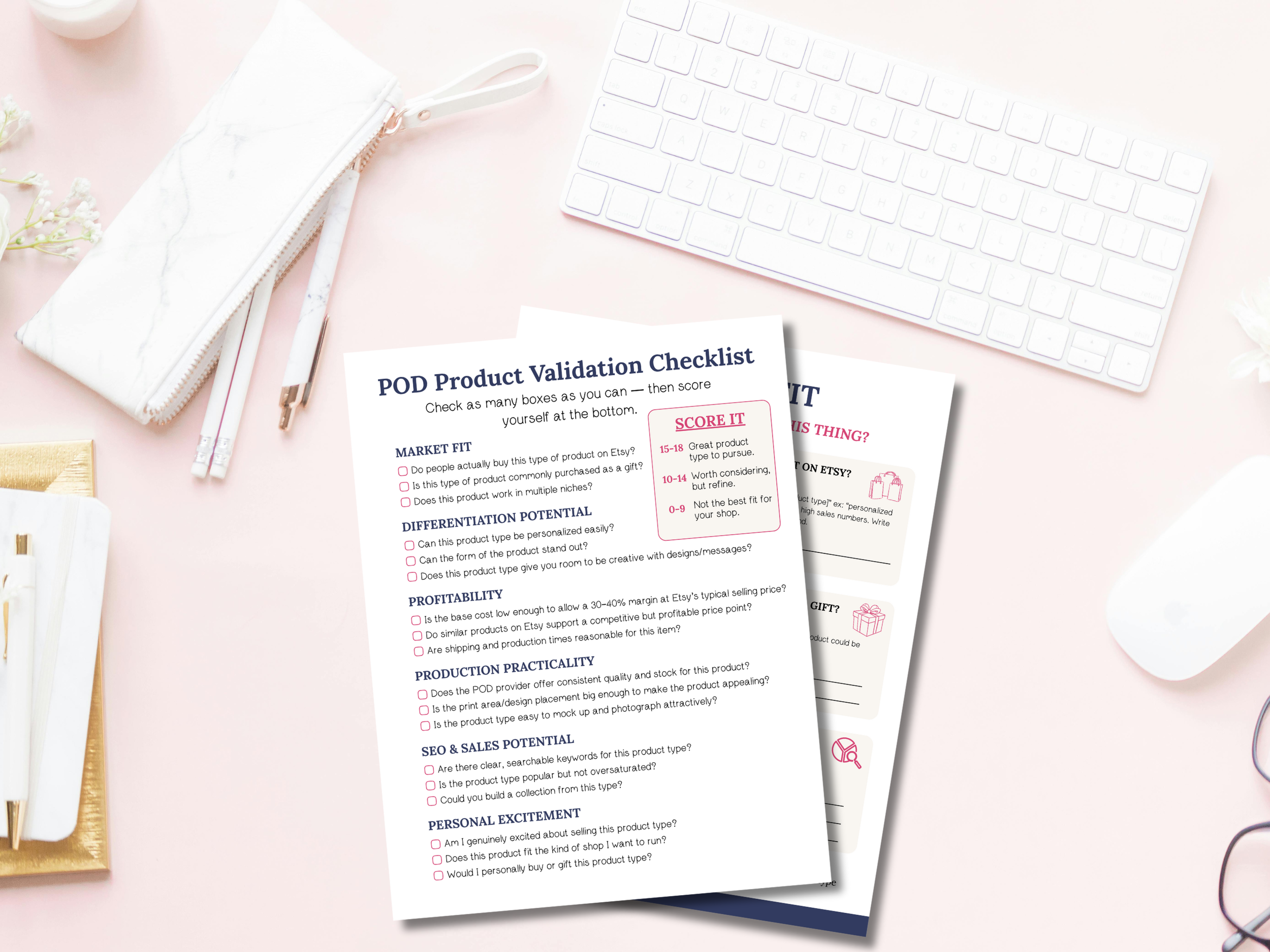
Use this free checklist to validate your next Etsy product idea — before you spend hours creating it.
